
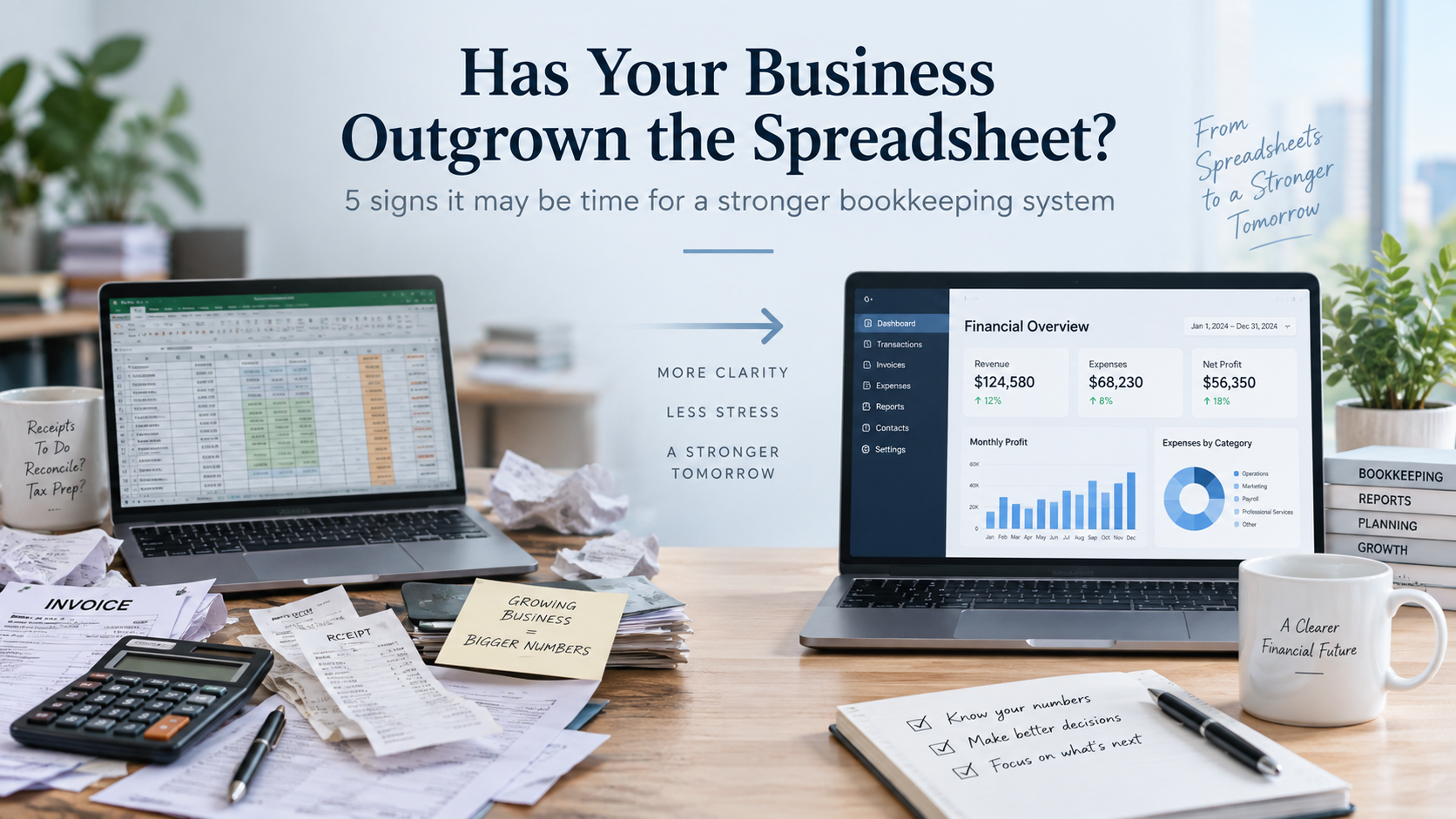
Your Business Has Outgrown the Spreadsheet. Now What?
Spreadsheets are incredibly useful.
They’re flexible, familiar, and inexpensive. For a brand-new business, they can be more than enough to track income, expenses, customers, or invoices.
But eventually, something changes.
The business gets busier. There are more transactions. More customers. More accounts. More ways money comes in and goes out.
And suddenly, the spreadsheet that used to feel simple starts to feel like one more thing you’re constantly trying to keep up with.
That’s usually a sign your business has outgrown it.
The Problem Isn’t the Spreadsheet
There’s nothing inherently wrong with using Excel or Google Sheets.
The problem is when your financial system becomes too dependent on manual updates.
Maybe you’re invoicing customers in Word or Excel.
Maybe you’re accepting payments through Square, Zelle, checks, or bank transfers.
Maybe expenses are spread across a business checking account, a credit card, and occasionally a personal account.
And maybe you’re tracking all of that in separate places.
Individually, each piece may work just fine.
Together, though, they can make it difficult to answer a very basic question:
How is my business actually doing?
Sign #1: You’re Entering the Same Information More Than Once
One of the first signs that a business has outgrown its spreadsheet is duplicate work.
You create an invoice in one place.
Then you record the payment somewhere else.
Later, you manually update a spreadsheet.
At tax time, you send another summary to your accountant.
Every time the same information has to be entered again, there’s another opportunity for something to be missed, duplicated, or entered incorrectly.
A good bookkeeping system reduces that repetition.
Instead of recreating information, the goal is to have transactions flow into one organized financial system.
Sign #2: You Don’t Fully Trust Your Numbers
This is a big one.
If you look at your spreadsheet and immediately wonder:
- Did I enter everything?
- Is this up to date?
- Did I include that credit card purchase?
- Did that customer actually pay?
- Does this number match what’s in the bank?
Then the issue isn’t necessarily your bookkeeping ability.
It may simply be that the system has become too manual to maintain reliably.
Financial reports are only useful when you trust the information behind them.
Sign #3: Your Bank Balance Has Become Your Financial Report
A lot of business owners manage their business by checking the bank account.
If there’s money in the account, things feel good.
If the balance gets low, it feels like something is wrong.
But your bank balance doesn’t tell you the whole story.
It doesn’t automatically tell you:
- how profitable you are,
- what customers still owe you,
- what bills are coming due,
- how much you’ve spent on a particular category,
- or whether your expenses are increasing faster than your revenue.
That’s where an actual bookkeeping system becomes much more valuable than a spreadsheet alone.
Sign #4: You’re Spending Too Much Time Maintaining the System
Another clue is the amount of effort required just to keep things organized.
Maybe you’re spending Sunday night updating a spreadsheet.
Maybe receipts are sitting in your email waiting to be entered.
Maybe you have several months of transactions you know you need to catch up on.
As the business grows, your time becomes more valuable.
At some point, manually maintaining a financial system can cost more in time and attention than the software or professional help needed to improve it.
Sign #5: You Need Better Information to Make Decisions
Early in a business, simply knowing how much money came in and how much went out may be enough.
Later, you start asking better questions.
Can I afford to hire someone?
Which services are most profitable?
Why did expenses increase this month?
How much cash should I keep in reserve?
Can I afford a new vehicle or piece of equipment?
Am I charging enough?
Those questions require more than a transaction list.
They require organized, reliable financial information.
So What Should Replace the Spreadsheet?
Usually, the answer isn’t to eliminate spreadsheets entirely.
Spreadsheets are still great tools for budgeting, forecasting, job analysis, and custom reporting.
But they work best when they sit on top of a solid bookkeeping system rather than acting as the bookkeeping system itself.
For many small businesses, that means using accounting software such as QuickBooks or Xero as the financial hub.
Your bank and credit card accounts can feed into the system.
Invoices and customer payments can be tracked.
Transactions can be categorized consistently.
Accounts can be reconciled.
And financial reports can be generated using current information.
The goal isn’t to add complexity.
It’s actually the opposite.
The goal is to create one reliable place where the financial picture of your business comes together.
Start With the Foundation
If your current system feels scattered, you don’t have to fix everything at once.
Start with the basics:
- Separate business and personal finances.
- Use a dedicated business bank account and credit card.
- Choose an accounting system that fits your business.
- Create a simple chart of accounts.
- Establish a consistent invoicing and payment process.
- Reconcile your accounts regularly.
- Review your financial reports each month.
Those pieces form the foundation for everything else.
Once the foundation is solid, you can start using your numbers to make better decisions instead of spending your time trying to figure out whether the numbers are accurate.
Final Thought
A spreadsheet is often exactly what a business needs when it’s getting started.
Outgrowing it is not a failure.
It’s usually a sign that the business itself has grown.
The important part is recognizing when your financial system needs to grow with it.
If your bookkeeping process feels increasingly manual, scattered, or difficult to trust, it may be time to build a stronger foundation.
Hawk Bookkeeping helps small businesses create organized, reliable bookkeeping systems so owners can spend less time piecing together their numbers and more time using them to run their business.